
 Click here to access the related GitHub repository
Introduction
Another one of my hobby is climbing. Indoor or outdoor, bouldering or sport climbing (with a rope), I fell in love with the sport in 2020. The fact that it combines physicality and balance with mental qualities such as determination and figuring out a problem (not to mention creativity) makes it a very complete and a very exciting discipline. So it is not really surprising that I also got into professional climbing competitions, which got a relatively increased hype and popularity over the past few years, especially since its introduction in the 2020 Tokyo Olympics and due to the rise of "superstar" Janja Garnbret. But climbing is a difficult sport to judge and rank due to its "all-or-nothing" nature (after all, either you reach the top or you don't). It is also one of those sports where athletes are competing versus each other to a certain extent, but mostly against the walls and the people who design the bouldering problems and lead climbing routes (called route-setters). This post dives into the topic of professional climbing competions and scoring.
Climbing is a difficult sport to judge and rank due to its "all-or-nothing" nature (after all, either you reach the top or you don't).
Project
I set out for two main objectives with this project and the exploration of climbing competitions results. The complete Jupyter Notebook can be accessed here.
- In anticipation for the 2024 Paris Olympics and its climbing event, I wanted to use a "ranker" model to see if I could predict the results based on historical results at various competitions on the circuit.
- As the scoring rules have evoled between the 2020 Tokyo Olympics and the 2024 Paris one, I wanted to recalculate what the results could have been at that competition if the new rules had been applied back then.
1. Predicting Paris 2024
IFSC, the international federation of sport climbing, has a continuous circuit of competitions throughout the year, similar to ATP and WTA for tennis. At each of these events in many different locations, climbers compete through a qualifications/semi-finals/finals format. After gathering the results of major and minor climbing competitions since the Tokyo Olympics in 2021 to the start of 2024, I set out to use a ranker model (XGBRanker) to focus on prediciting the order of the contestants at a future competition. The methodology only relies on comparing pairwise the most common order in which contestants finished to predict what is the most likely order when presented with a set of entries. I submitted on 9 of the most popular (and likely) contestants to have a shot at the win in Paris and obtained the predicted ranking below.

Edit: when I originally did this analysis, the 2024 hadn't happened yet. Now the results are here and obviously my model not predicting Janja Garnbret to win was always going to be wrong. Brooke Raboutou did finish second, and Jessica Pilz third similar to the model's prediction. Miho Nonaka and Natalia Grossman actually failed to qualify for the final, while Ai Mori finished 4th and Chaehyun Seo 6th. "Surprised" Erin McNeice and Oceana McKenziw finished 5th and 7th while Oriane Bertone, predicted first my the model, crumbled under the pressure in the finals and finished in 8th.
2. Revisiting the past: what Tokyo 2020 could have been
Background
In its first introduction to the Olympics in 2020, climbing took the form of a triple event.
Speed climbing, bouldering and lead climbing formed part
of a single classification to determine medal, with the rankings at each one of the three events
simply being multiplied together to give the final
order. This came with a lot of criticism from fans (and athletes), mostly because speed climbing
relies on completely different qualities compared to
the other two events. The total ranking method was also questionable as someone doing vastly
better at say, bouldering, but slightly inferior at
speed would be penalized.
For the 2024 edition, speed climbing was separated from the other two and given its own
event and medals. We will not focus on it for this
analysis. Bouldering and Lead remained combined, with event having a possible maximum 100 points
to score, then both scored tallied up to give the
final ranking. Now I will go slightly more into details about the calculation of these scores as
it was the whole point of this study.
Bouldering scoring
The bouldering event at the 2024 Olympics was scored as follows: 4 boulder "problems", each one awarding a maximum of 25 points for completing it (for a maximum total of 100 points). Not reaching the top but reaching intermediate "zones" is also rewarded, with the lower zone awardin 5 points, and the higher one 10. Finally, each subsequent tentative and restart (in the imparted time) deducts 0.1 points (mostly to separate ex aequo).Back in Tokto 2020, the was no point system since all that mattered was the ranking. Athletes were separated first my the number of tops (finishing the problem), then the number of zones (there was just one intermediate zone, halfway through each problem), and finally the number of attempts. The score would look something like "2T3z 5 3" which mean 2 tops, 3 zones, 5 top attempts, 3 zone attempts (over 3 boulders).
It is difficult to compare the score between 2020 and 2024 but I've chosen the following assumptions:
- to transpose the scores to a scale of 0-100, each boulder will be worth 25 points (for the qualifications, 4 problems) or 33 points (for the finals, 3 problems)
- there was only one zone in Tokyo, for which I decided to award 40% of the points (so 10 in the qualifications, 13 in the finals). A value of 30% would also make sense
- like the current rule, 0.1 points would be deducted by attempt
Lead climbing scoring
The lead event is slightly more straightforward to score. There is only one route and one attempt to climb it, the first fall being definitive and we then take the highest point the climber reached as their final score. The scoring method now (and in Paris 2024) consists in awarding a total of 100 points as well, spread out over the top 40 holds a climber has to use to reach the top. The last 10 holds award 4 points each, the 10 before that 3 each, etc.Again, in Tokyo, athletes were only compared and ranked based on how high they got. We know the number of moves they completed so we can apply the same scale, calculating the number of moves to reach the top, and then giving 4 points for each of the holds used in the 10 below that, then 3, then 2, then 1.
Results and comparison
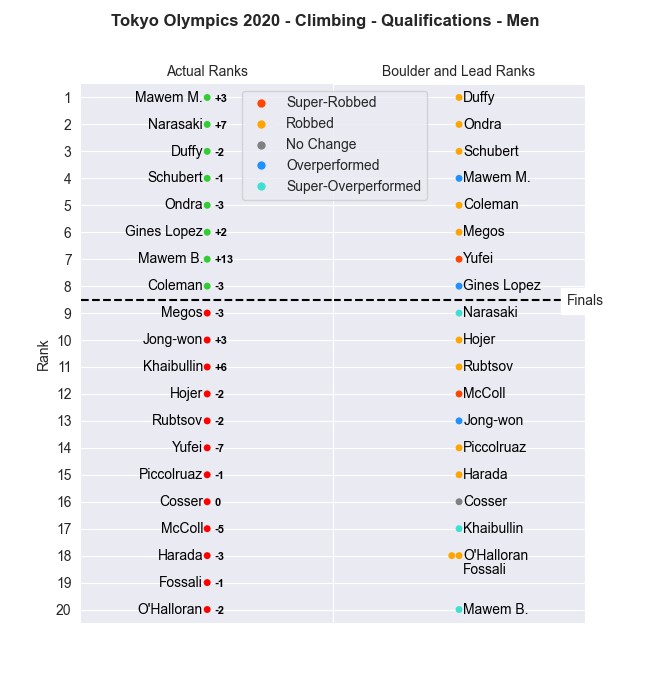
After applying those calculations to re-estimate the score the athletes would have gotten in Tokyo if the assu and methods described above had been applied, we can compare their final score and position to the one they actually got. Note that we are discarding the speed climbing event in our adjusted calculation as we want to just estimate the rank they would have obtained if it had just been a separate Boulder & Lead competition, like in Paris 2024.The qualifications, in which the athletes need to place in the top 8 to proceed, would have been quite impacted. For men, Bassa Mawem, a speed specialist qualified in 7th while if only boulder and lead had mattered he would have been last... Alex Megos, a German climber, could have had a shot at a medal but in Tokyo setting, only placed 9th in qualifications. Finally, Gines Lopez, future gold medalist, would have barely made the cut to the finals if only Boulder and Lead counted.
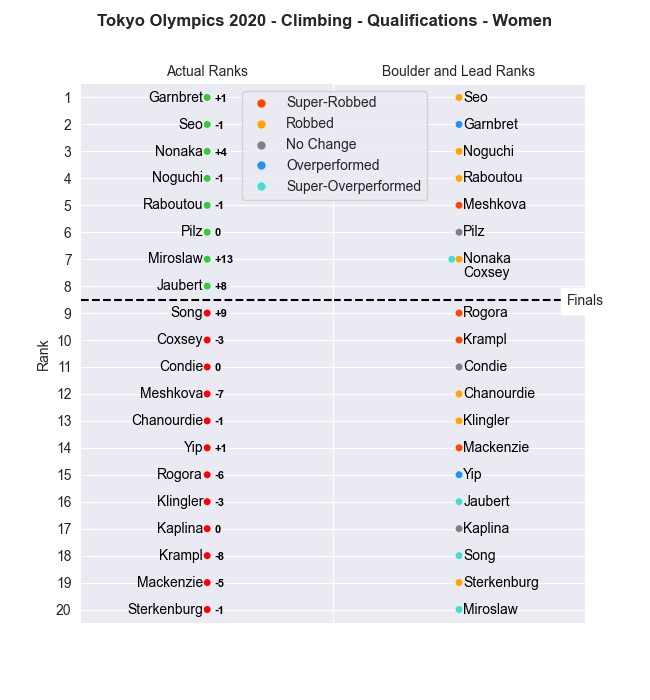
For women, the observations are similar. Miroslaw and Jaubert, 7th and 8th in the qualifications, greatly owe their ticket for the finals to their speed performance. Shauna Coxsey, a famous, veteran climber form the UK, narrowly missed on the finals but would have made it if it was just Boulder & Lead. The more balanced (and generally stronger) climbers that are Janja Garnbret, Chaehyun Seo, Miho Nonaka, Jessica Pilz or Brooke Raboutou would all have made the finals either way though.
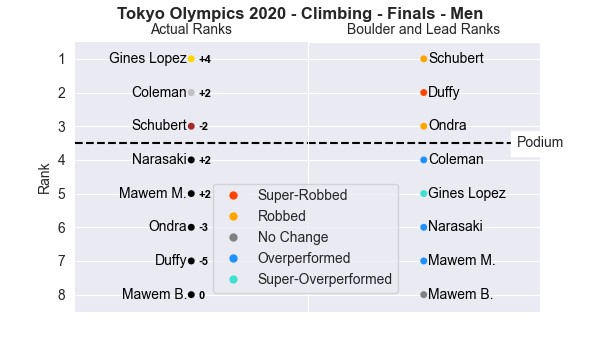
In the men finals, Alberto Gines Lopez eventually obtained the gold medal, largely due to his strong performance on the speed and lead events. But his poorer performance in bouldering would have meant he would have only finished 5th with Paris 2024 rules. Austrian Jakob Schubert would have upgraded his bronze medal for the gold one, while crowd favorite Adam Ondra could have clinched 3rd instead of his 6th place.
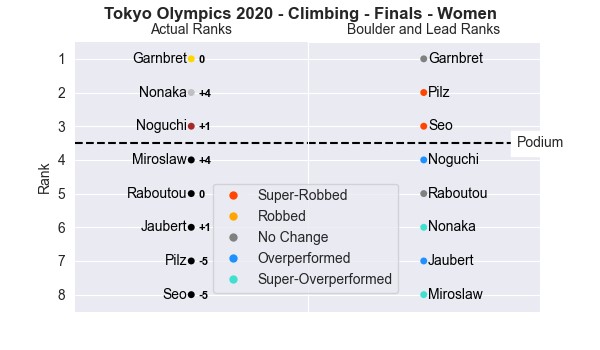
Finally, for the women finals, nothing would have changed the complete domination of Janja Garnbret. But the podium would have looked very different with Pilz and Seo finishing 2nd and 3rd instead of 7th and 8th if their poor speed climbing performance didn't matter.
Conclusion
There are a few obvious flaws with an analysis like this one. First, the rules were what they were in Tokyo and it meant that all climbers trained for all 3 events, not just two. Still, most people agree that the qualities needed for Boulder and Lead are closer and make more sense to group together these events than the Speed one. The point system and the two zones were also not in place in Tokyo, making the calculations and projections I made highly contestable. Finally, the words I used on the charts above such as "robbed" are just there to attract attention to the results of the comparison, I do not mean that anyone did not deserve their final ranking in Tokyo!